

How to Choose Quality Supplements and Spot the Red Flags
Walk down any supplement aisle, and the choices can seem infinite. Two bottles may list the same nutrient, yet their contents can differ in purity, potency, and absorption. For that reason, knowing how to choose quality supplements helps you invest in products that match their labels. This guide explains what to look for, from lab testing to ingredient forms, so you can shop with confidence.
Why Supplement Quality Varies Between Brands
The U.S. Food and Drug Administration (FDA) regulates dietary supplements differently than prescription drugs. Under the Dietary Supplement Health and Education Act of 1994, supplements do not require FDA approval before they reach store shelves. Instead, manufacturers hold responsibility for the safety of their products and the accuracy of their labels.
However, every manufacturer must follow Current Good Manufacturing Practices (cGMP). These federal rules require companies to set and verify specifications for identity, purity, strength, and composition. To confirm a product comes from a cGMP-compliant facility, check the label or the company’s website. Still, standards for raw materials, formulation, and testing vary widely from company to company. As a result, a label alone may not tell the whole story.
How to Read a Supplement Label
A supplement label holds many clues about product quality. However, the most useful facts often sit in small print. The sample label below highlights six areas to review before you buy.
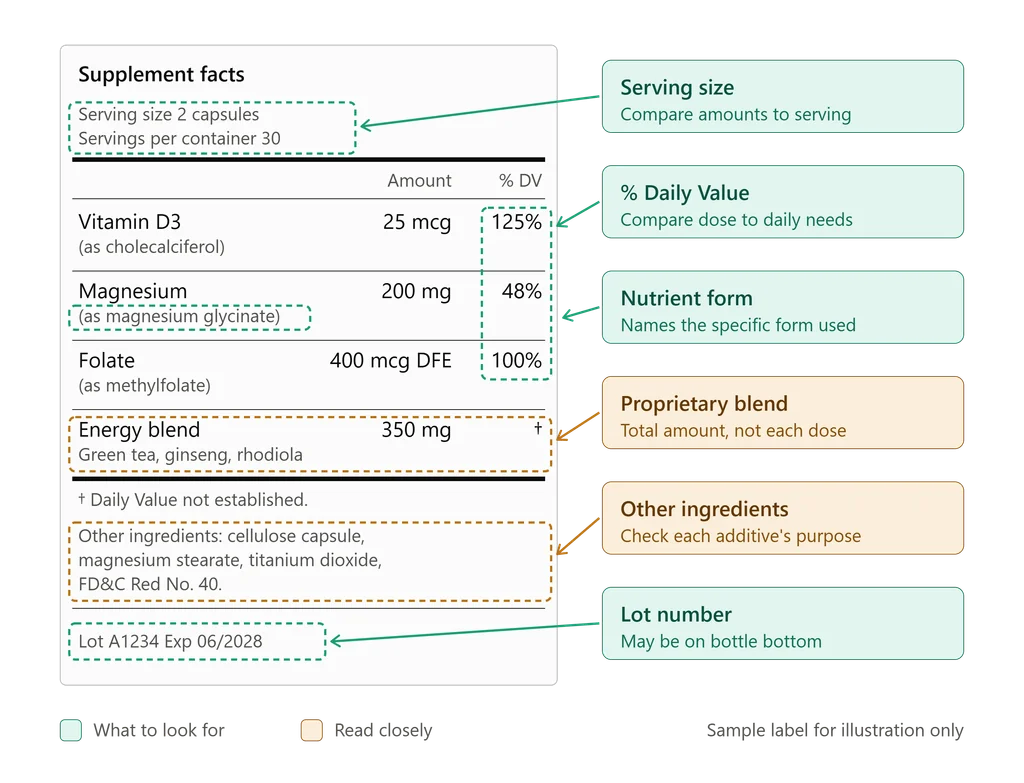
Start with the serving size, since every amount on the panel reflects that serving. Pay close attention to each ingredient amount, and compare it to the serving size when applicable. For example, a dose listed for two capsules delivers only half that amount if you take one. Next, check the % Daily Value to see how each dose compares with general daily needs, as set by the FDA and not necessarily based on optimal doses. So don’t be concerned if it is over 100%. Then, look for a proprietary blend, the other ingredients list, and the lot number. The sections below explain each area in more detail.
Lab Testing: A Key Step in Choosing Quality Supplements
Lab testing confirms what is actually inside a supplement. Typically, testing verifies that the ingredients on the label are present in the stated amounts. Many labs also screen for contaminants such as heavy metals, microbes, and pesticides.
The results appear on a Certificate of Analysis (COA), which is a lab report for a specific production batch. A COA shows whether each batch meets its specifications for identity, potency, and purity. For this reason, the lot number matters, because it links your bottle to its batch report. You can usually find it on the label, although some brands print it on the bottom of the bottle. Reputable brands review these reports carefully before products reach customers.
Spot Fillers and Additives on Supplement Labels
Not every inactive ingredient is a problem. In fact, some additives serve practical purposes. Binders hold tablets together, while flow agents keep powders from sticking to equipment during production. Nevertheless, some products contain more additives than the formula truly needs.
Examples include artificial colors, artificial sweeteners, added sugars, and titanium dioxide. Notably, the European Union banned titanium dioxide as a food additive in 2022. For this reason, many shoppers prefer formulas with short, simple “Other Ingredients” lists. Therefore, read that section of the label as carefully as the nutrient panel.
Proprietary blends also deserve a closer look. Federal labeling rules require a blend to list its ingredients and total weight, but not the amount of each ingredient. Blends allow formulators to combine complementary ingredients in a single serving. Still, if you want details about a specific ingredient, ask the company directly.
Choose Quality Supplements in Absorbable Forms
Bioavailability describes how much of a nutrient your body can absorb and use. Because nutrients come in different chemical forms, absorption can vary considerably. For example, a mineral bound to an amino acid, known as a chelate, tends to dissolve more readily in the digestive tract. Similarly, some vitamins come in active forms that your body can use without extra conversion steps.
| Nutrient | Common Form | Often-Preferred Form | How it Works |
| Magnesium | Magnesium oxide | Magnesium citrate or glycinate | These forms dissolve more readily than oxide, which supports absorption in the intestine. |
| Folate | Folic acid | Methylfolate (5-MTHF) | Methylfolate supplies the active form directly, so the body skips the enzyme conversion step. |
| Vitamin D | Vitamin D2 (ergocalciferol) | Vitamin D3 (cholecalciferol) | D3 matches the form your skin produces and raises blood vitamin D levels more effectively in most studies. |
In short, the form on the label matters as much as the dose.
Red Flags to Watch for When Choosing Quality Supplements
Certain warning signs suggest a product may not meet quality standards. Watch for these red flags:
- Unnecessary fillers: A long “Other Ingredients” list can mean the formula contains more additives than it needs. Some additives raise particular concern:
- Titanium dioxide: The European Union banned this whitening agent as a food additive in 2022 after safety reviewers could not rule out concerns about DNA damage.
- FD&C Red No. 3: The FDA revoked its approval in foods and ingested drugs in January 2025 after high doses caused cancer in male laboratory rats.
- Partially hydrogenated oils: The FDA no longer considers these oils, the primary source of artificial trans fat, generally recognized as safe.
- Artificial colors and sweeteners: These additives change a product’s appearance or taste but provide no nutritional value.
- No COA: A brand that cannot confirm lab testing through a Certificate of Analysis gives you no way to verify what is in the bottle.
- Exaggerated promises: Words like “miracle,” “instant results,” or “works for everyone” often signal marketing rather than science.
- Disease claims: Supplements cannot legally claim to cure, treat, or prevent disease. Language such as “cures arthritis” signals a brand that may not follow federal rules.
- Missing company information: Federal rules require the label to list the name and place of business of the manufacturer, packer, or distributor.
Questions to Ask When Choosing Quality Supplements
Before adding a new product to your routine, consider these questions:
- Is the product made in a cGMP-compliant facility?
- Does the company lab-test each batch and verify the COA?
- Does the label name the specific form of each nutrient?
- If the formula includes a proprietary blend, can the company answer your questions about it?
- Does each additive in the “Other Ingredients” list serve a clear purpose?
- Who manufactures the product, and how long have they been in the industry?
Clear answers signal a transparent brand.
Final Thoughts on How to Choose Quality Supplements
Learning how to choose quality supplements comes down to transparency, testing, and thoughtful formulation. At Physicians Preference Vitamins, physician-formulated nutrition sits at the heart of everything we offer. We partner with a select group of long-established manufacturers, and each product comes from a cGMP-compliant facility in the United States. Every product undergoes lab testing, and our team verifies the Certificate of Analysis for each one. In fact, we have rejected batches in the past when the results did not meet our standards. Our formulas also feature absorbable nutrient forms and avoid unnecessary fillers.
Have questions about which products fit your goals? Call our certified nutritionists at 281-646-1659 for custom guidance.
*These statements have not been evaluated by the Food and Drug Administration. These products are not intended to diagnose, treat, cure, or prevent any disease.